

Many manufacturers believe that good products and competitive pricing are enough to find distributors in Vietnam.
In reality, Vietnamese importers are increasingly focused on one thing:
Can the manufacturer support Vietnam registration requirements?
Without the right documentation, even the best product cannot be legally marketed in Vietnam.
The 3 key factors importers usually look for are:
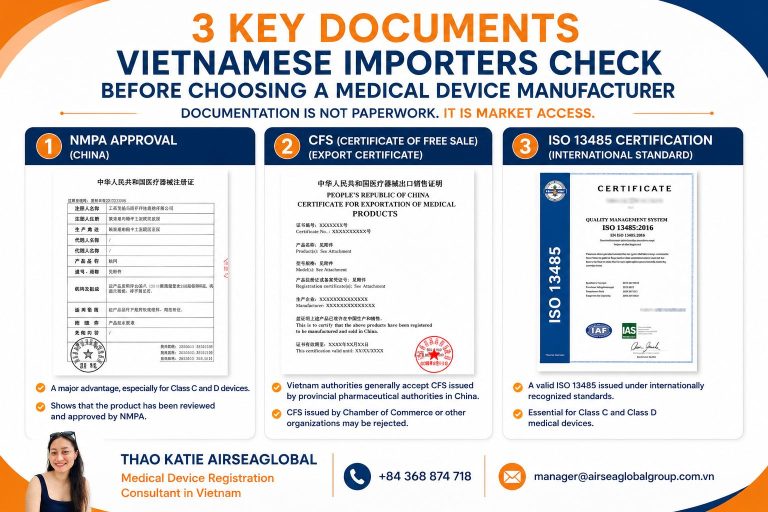
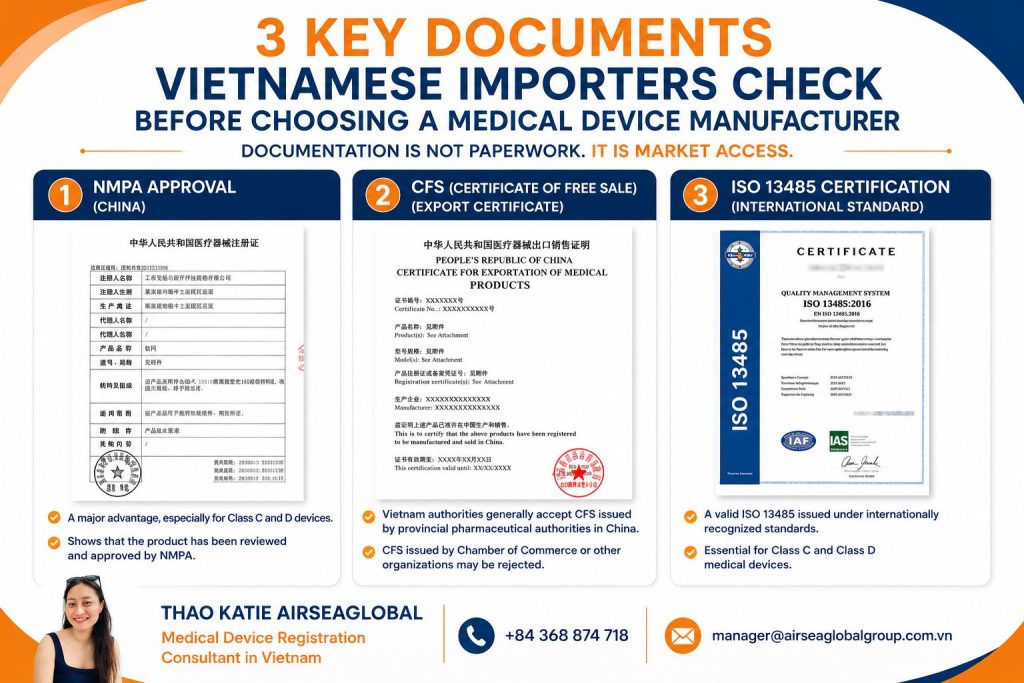
1. A valid CFS
For Chinese medical devices, Vietnamese authorities generally accept CFS issued by provincial pharmaceutical authorities.
Many registration dossiers face difficulties because the manufacturer only provides a CFS issued by a Chamber of Commerce or other organizations.
2. International ISO 13485
Many manufacturers hold local quality certifications, but Vietnam requires a valid ISO 13485 issued under internationally recognized standards.
For Class C and D medical devices, this is especially important.
3. NMPA approval or approvals in developed markets
Products already approved by NMPA or marketed in the US, UK, EU, Australia, Japan, South Korea, or Canada have a significant advantage.
These products are often viewed more favorably by Vietnamese importers and usually have stronger regulatory documentation.
In my experience, the difference between a complete dossier and an incomplete one can mean months versus years in the registration process.
Today, regulatory readiness is becoming just as important as product quality and pricing.
In the medical device industry, documentation is not paperwork. It is market access.
— Thao Katie Airseaglobal
📞 +84 368 874 718 (zalo, Whatapp, Viber)
📧 manager@airseaglobalgroup.com.vn | thuthao@airseaglobalgroup.com.vn
